
The Fine Line Between Peak Performance and Breaking Down: Why Athletes Need Sports Massage
As an athlete, you invest countless hours into your intervals, long runs, and nutrition. But there is a silent metric in your training log that determines whether you shatter your personal best or end up sidelined for months: how you manage muscular tension.
Many endurance athletes view sports massage as an emergency luxury—something to book only when a sharp pain appears. But by that time, the damage is already done.
Understanding the simple body mechanics of how muscles function reveals why regular bodywork is a non-negotiable tool if you want to stay at the peak of your game.
The Mechanics of an Injury: Muscle Bellies vs. Tendons
To understand why tension triggers injuries, let’s look at how your moving parts interact.
A muscle consists of two main parts:
- The Muscle Belly: The soft, central part of the muscle that has the ability to actively contract (shorten) and lengthen.
- The Tendons: The dense, rope-like attachments at the ends of the muscle that anchor it securely to your bones. Tendons do not expand or contract; they act purely as anchors.
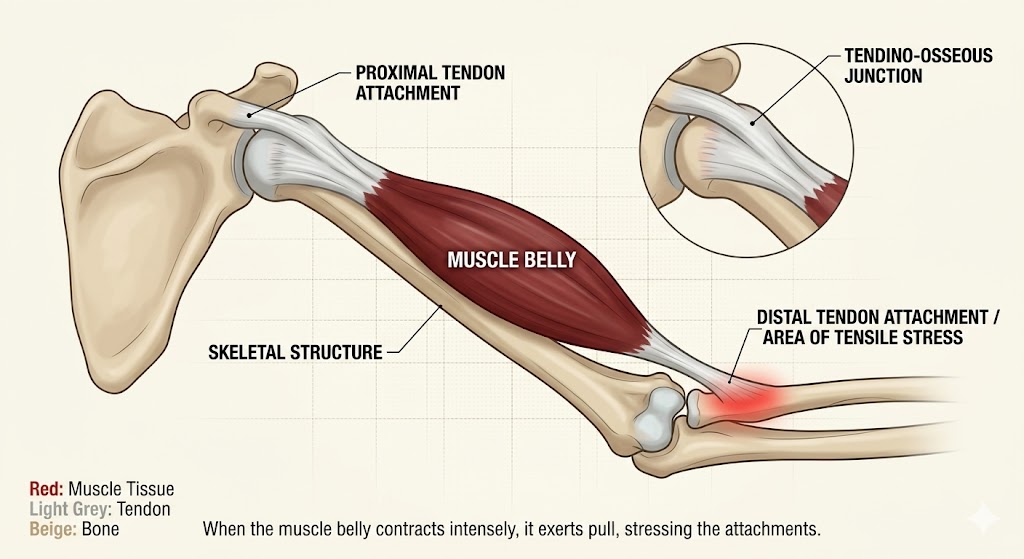 When you train heavily, your muscle bellies become chronically tight and shortened. Because they cannot stretch easily in this state, they begin to constantly tug on the tendons. Think of it like a taut rope pulling aggressively against its anchor point.
As you continue to cycle, swim, or run with this underlying tension, that constant mechanical pulling creates microscopic tears in the tendon tissue. Eventually, your body flags this damage with pain and inflammation. Say hello to tendonitis. ---
Three Common Paths to an Athletic Injury
In my studio, I typically see athletes fall into one of three distinct tension traps:
- The Sudden Spike: You normally run 6–8k per session, but a friend convinces you to join them for a sudden 21k half-marathon. This abrupt, unadapted change in volume triggers instant inflammation.
- The Aggressive Build: You sign up for an upcoming race and rapidly double or triple your weekly running volume (e.g., jumping from 20k to 50k a week). Without a gradual ramp-up, your body breaks down under the load.
- The Silent Accumulation: You are training heavily and staying at peak volume. Everything feels fine, but tension is slowly, silently accumulating in your legs or shoulders. Your foam roller stops working and your massage gun isn't doing much anymore. You don't feel "pain" yet, so you ignore the warning signs and keep pushing. This is the most common path to a major overuse injury.
Navigating Your Self-Care Tools (With Caution)
Athletes often try to beat injuries using a mix of tools, but without understanding the mechanics, these methods can easily backfire:
1. Strength Training
Gym work is vital for triathletes, but timing is everything. Your legs are already taking a beating from running and cycling. Adding heavy leg days right on top of exhausting endurance sessions creates excessive soreness and damages tired tissue. Always choose exercises that support your current functionality, and consult your coach to schedule gym days cleanly away from your heaviest endurance blocks.
2. Stretching and Flexibility
Stretching definitely helps, but it requires strategy. Before a workout, focus exclusively on dynamic stretching (active movements like leg swings and arm circles) to wake up the nervous system. After training, utilize passive stretching (holding a relaxed position for 30 seconds).
Important Note: If your muscles are already inflamed or highly micro-torn from a brutal session, heavy stretching can actually worsen the microscopic tearing. Sometimes, leaving the tissue alone to rest is the smartest choice.
3. Foam Rollers & Massage Guns
Most triathletes own a foam roller or an expensive, heavily promoted massage gun. Do they work? Yes, but only with caution.
As we've discussed before, rolling a completely straight leg on the floor keeps the target muscle under high mechanical tension, making it nearly impossible to actually release. Furthermore, if you already have an underlying injury or localized inflammation, aggressively smashing a hard plastic roller or a vibrating massage gun into that sensitive spot will only bruise the tissue and cause your nervous system to tighten up even further to protect itself.
The Professional Difference: Soft, Targeted Massage
When tension has built past the point where self-care tools can help, visiting a professional massage therapist is the fastest way to restore safety to your tissue.
If your muscles are already heavily overworked and mildly inflamed, a brutal, aggressive sports massage is a terrible idea—it adds more trauma to an already traumatized area. Instead, the INTUNE method utilizes a fluid, therapeutic approach. By combining targeted heat from hot stones to melt superficial resistance with soft, localized fascial releases and Thai stretching, we remove the deep tension and restore natural muscle elasticity without causing defensive pain.
Staying on Top of the Game
At INTUNE Holistic Massage, we firmly believe that prevention is infinitely better than reaction.
- For Structured Athletes: If you train in typical blocks (e.g., 3 heavy weeks followed by 1 recovery week), the absolute best time to schedule your massage is during your recovery week to flush out metabolic waste and reset muscle length.
- For General Fitness Athletes: If you don't follow a strict competitive calendar, scheduling a maintenance session once a month ensures you stay ahead of the tension curve.
- For Chronic Tightness: If you feel an area getting progressively tighter but no sharp pain has started yet, schedule 2–3 sessions close together. Clearing the restriction immediately allows you to keep training safely. If you wait until you feel actual pain, you will likely need to stop training altogether and visit a physiotherapist or doctor.
Your Progress is an Investment

You want to improve. You want new personal records, a spot on the podium, and to become the absolute best version of yourself.
To get there, time is your most precious asset. When you get injured, you don't just take a break—you drop down to square zero and lose months of hard-earned progress. Your muscles lose their explosive strength, your conditioning drops, and your VO2 max goes down.
The money and time you invest into keeping your body supple, aligned, and healthy directly determines how fast you can progress in your sport. If you are serious about moving forward, take care of your body before it forces you to stop.
Feeling that familiar, heavy tension right now? Don't wait for the pain to sideline you. Book your recovery session at INTUNE Holistic Massage today.